
By Max Kornetzke, Land Manager
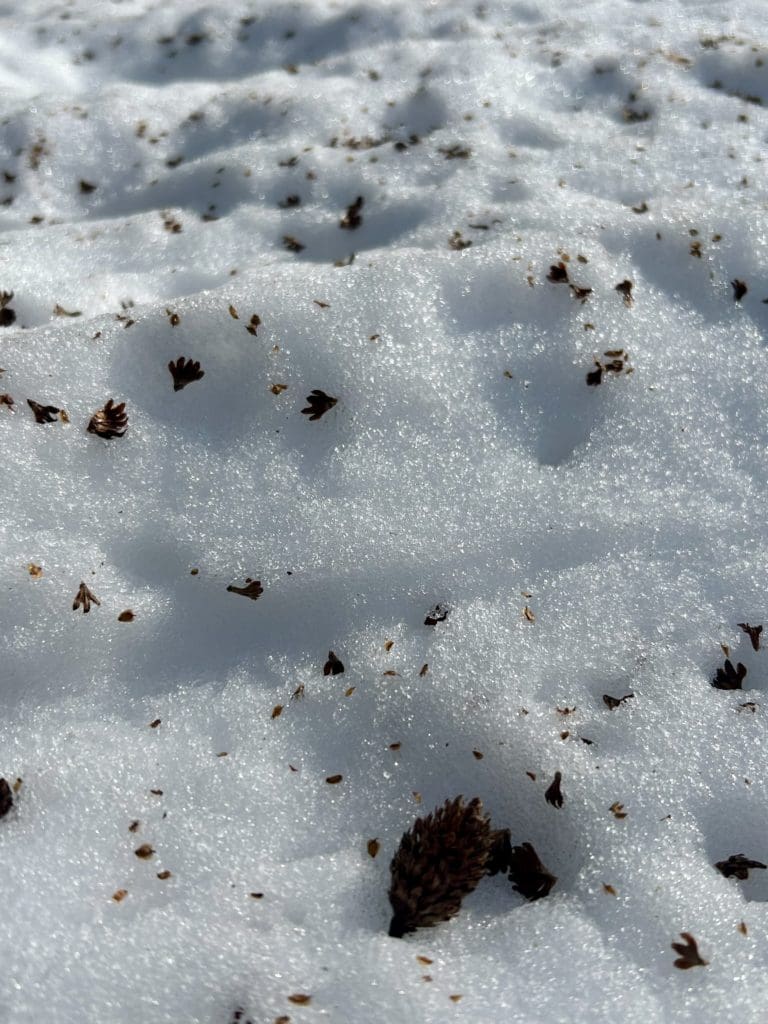
My eye is drawn to the rippling patterns the wind creates with snow. Their forms
echo lakeshore sand dunes or the rolling terrain of an old growth forest.
Sometimes I’ll see repetition of long linear forms that remind me of the ridge and
swale topography of Woodland Dunes and Point Beach.
Atop these drifts and along our trails, the wind carries other things into view. I
often encounter small papery seeds and bird-shaped scales scattered gently on
the surface. Yellow Birch (Betula alleghaniensis) is a common tree at Woodland
Dunes. They hold their small, winged seeds between those bird-shaped scales
flocked together in a cone-like cluster until the gusts of winter knock them free
from the treetops.
This is the perfect time for them to spread across the landscape. They will blow
with the wind skating across the surface. The next round of snow will seal them
in place until thaw. As winter melts away, they will sink down, hopefully finding a
nice bed of moss or exposed mineral soil to rest in until the right temperature is
struck to signal transformation.
There are many beautiful specimens here, large and small. They have a notable
range of color in their exfoliating bark. Younger trees exemplify their namesake
with a distinct golden hue. As they mature the bark breaks and peals in strips,
exposing various shades of pearlescent cream, gold, bronze, brown and gray.
The cool, humid forests they thrive in produce various shades of green and blue
lichen polka-dotting their limbs.
Yellow Birch loves to grow on old, decaying wood. Some of my favorite trees in
the preserve have germinated on tall stumps, with distinctive roots that have
traveled several feet to the forest floor, slowly engulfing the old tree. Eventually
those stumps will rot away and the birch is left looking like it’s grown on stilts.
These trees are long lived, but sometimes a winter squall will pass through and
tip them over. The snow will collect on top of its fallen trunk creating new icy
patterns. Moisture is trapped, seasons come and go, and the old tree
decomposes. Eventually, the winter wind carries a new papery seed along and
the pattern begins again.