Written by Max Kornetzke, Land Manager
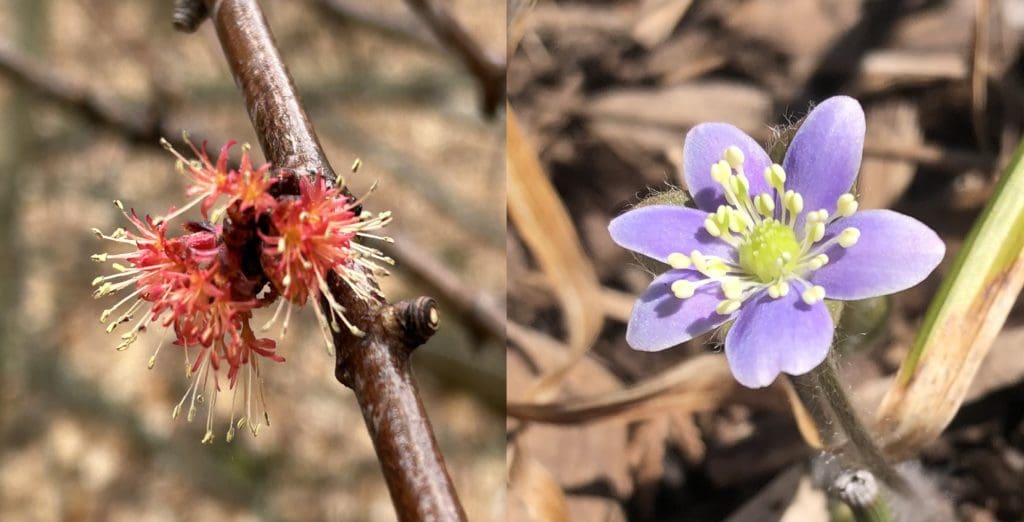
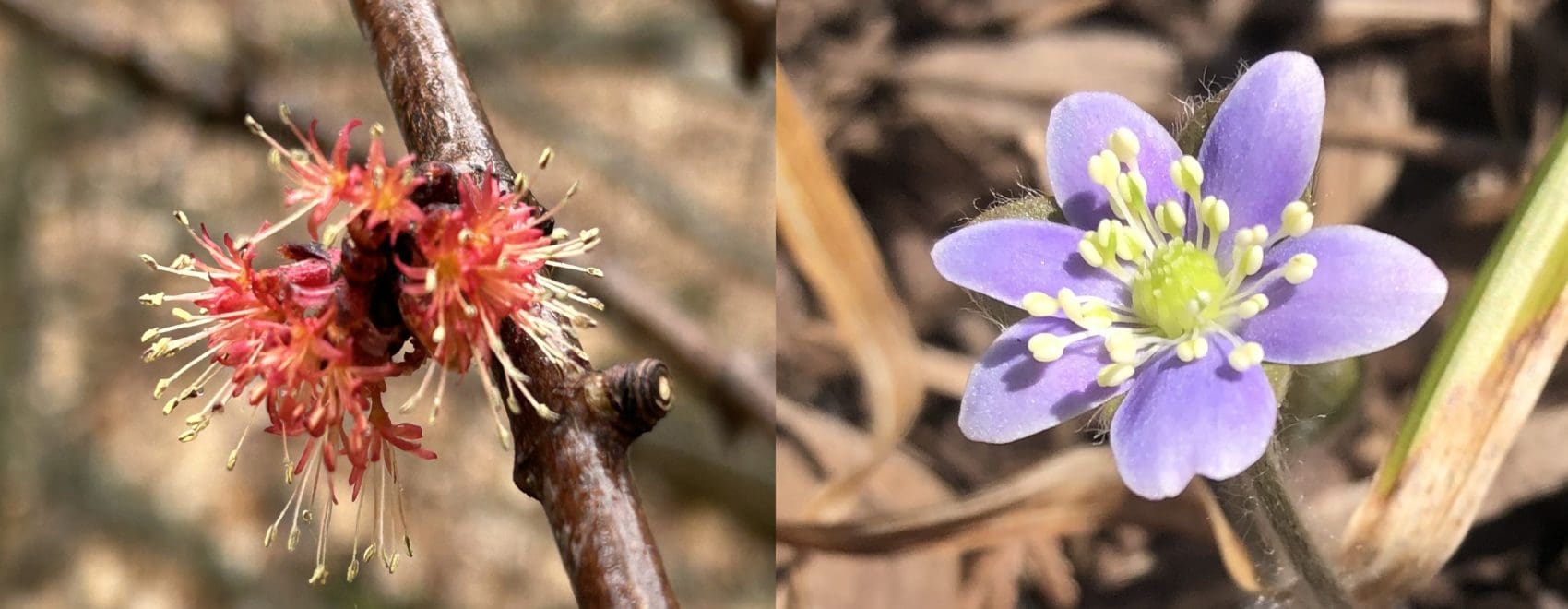
The earliest flowering plant I’ve noticed this year lives amongst the canopy of our woodlands. Red maple (Acer rubrum) is a common tree across many forest types. Red maple is true to its name with leaf and flower buds, emerging flowers and leaves, leaf stalks, fresh seeds, and autumn color all having beautiful red pigmentation. Another closely related tree, silver maple (Acer saccharinum) also has red flowers and can be seen flowering across floodplain forests and urban yards at the same time. Both of these species are generally wind pollinated, but some early pollinators do visit their flowers as well. They are also able to hybridize and produce offspring called Freeman’s Maple (Acer x freemanii).
In wetland thickets you will encounter the earliest flowering shrubs of Wisconsin. Pussy willow (Salix discolor) has already begun to push out its iconic cottony catkins. Soon showy yellow anthers will emerge on male catkins and smaller yellow-green stamens on female catkins. These flowers are highly attractive to the earliest bumblebee species as well as other spring foraging pollinators. For this reason, as well as the fact that the willow genus (Salix) is host for over 300 species of butterflies and moths, pussy willow is considered a keystone species for our local ecosystem.
Another wetland thicket species with early emerging flowers are speckled alders (Alnus rugosa). Speckled alders also have catkins, but these develop on the plant in late summer, persist through winter and open when spring conditions are just right. Speckled alder is wind pollinated, with bright yellow pollen present in late March and early April. If you lightly tap their catkins you can see the yellow pollen waft through the air.
Under these thickets you may encounter one of our earliest wildflowers. Skunk cabbage (Symplocarpus foetidus) is a common plant that thrives in wet, swampy woodlands. Its alien looking flowers emerge from the ground, creating heat in a process called thermogenesis to melt snow and create a warm microclimate around themselves. Their flowers are composed of a blood red modified leaf called a spathe which protects the interior flower spike called a spadix. They produce a putrid smell that attracts small flies and gnats to pollinate its flowers.
Other native wildflowers, though unrelated to skunk cabbage, have converged on the same thermogenic tactic. Round-lobed hepaticas (Hepatica americana) and Sharp-lobed hepaticas (Hepatica acutiloba) are two closely related species found in upland forest settings. As their name suggests, they can be distinguished from each other by whether their leaves are rounded or come to a point. Their beautifully mottled leaves often persist through the winter, taking on a deep purple pigmentation. They will produce internal heat so that their showy, cheerful flowers can emerge. Their flowers are classic and come in a range of colors from violet, to lavender, light pink or white.
The final harbinger of spring is a rarity. It doesn’t produce thermogenesis, but has found other ways to open its flowers early. Snow trillium (Trillium nivale) is one of the smallest native trillium species in North America. It looks similar to the more common large-flowered trillium (Trillium grandiflorum), but is diminutive in size. It grows in woodlands on limestone substrates and other alkaline soils. Snow trillium is considered a threatened species in the state of Wisconsin. It is also considered threatened or endangered in over half of the states it’s present in. If you’re lucky enough to encounter this plant, be careful not to disturb its habitat. Treasures like the snow trillium deserve to persist on our landscape in perpetuity.